
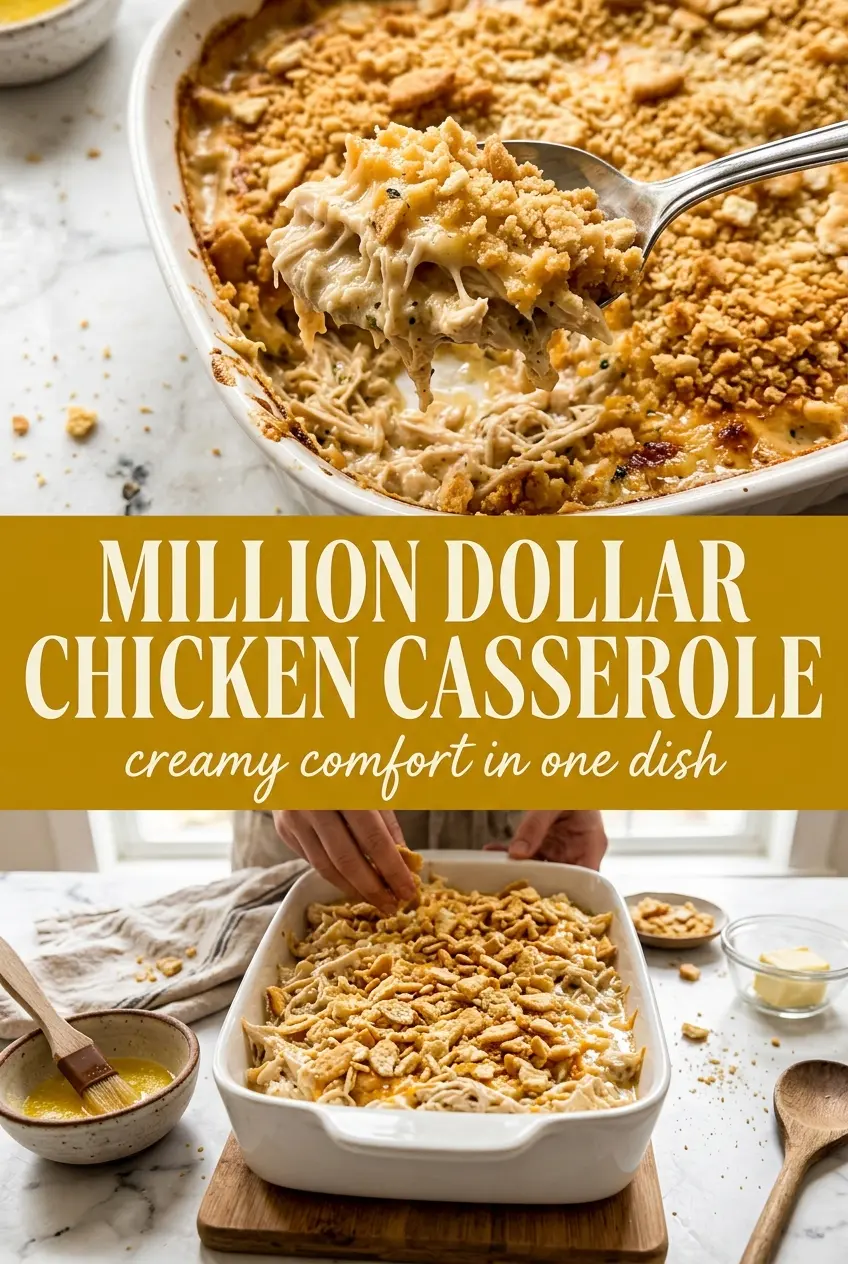
Million Dollar Chicken Casserole lands on the table with the kind of creamy, bubbling center and buttery cracker top that makes people hover near the oven. The filling stays soft and rich without turning heavy, and the Ritz crust gives every scoop a salty crunch that cuts through the sauce. It feels like comfort food from the first bite, but it also has enough structure to slice cleanly if you let it rest for a few minutes.
What makes this version work is the balance inside the filling. Cream cheese gives it body, sour cream adds tang, cottage cheese adds a little lightness and a smoother finish than you might expect, and the condensed soup ties everything together without needing a separate sauce. The chicken should already be cooked and shredded so it can soak up the filling instead of drying out in the oven. The cracker topping goes on raw, then bakes in butter until it turns deeply golden and crisp instead of greasy.
Below, I’ve included the small details that keep the casserole creamy instead of gluey, plus a few swaps for when you need to work with what’s in the fridge. The same method also scales well for a larger pan if you’re feeding a crowd.
The filling stayed creamy all the way through and the Ritz topping got perfectly crisp, even around the edges. I made it with rotisserie chicken and it was gone before I could pack up leftovers.
Save this Million Dollar Chicken Casserole for the nights when you want a creamy, golden-topped dinner that bakes up with almost no fuss.
The Creamy Filling Needs Gentle Heat, Not Extra Mixing
The filling for this casserole can go wrong in a few very predictable ways. If the cream cheese is cold, you’ll chase little lumps around the bowl and end up overmixing the chicken later. If you beat it hard once the chicken goes in, the texture can turn dense instead of plush. The goal is a smooth, spoonable mixture that holds together but still looks soft when it goes into the dish.
The other trap is assuming the soup alone will do all the work. It helps, but the cream cheese and sour cream are what give the casserole that thick, rich body. Cottage cheese may sound like a shortcut ingredient, yet it earns its place here because it melts into the filling and adds moisture without making the casserole oily. Stir just until everything looks evenly combined, then stop.
What Each Ingredient Is Actually Doing in This Dish

- Cream cheese — This is the base that gives the casserole its rich, almost velvety texture. Soften it first or it won’t blend smoothly with the other dairy ingredients. If you only have whipped cream cheese, it will work, but the filling will be a little lighter and less dense.
- Condensed cream of chicken soup — This brings salt, body, and the familiar savory chicken flavor that makes the casserole taste finished without a long ingredient list. A store-brand can works fine here. If you want to swap it, use cream of mushroom for a slightly earthier version, but the flavor will change noticeably.
- Cottage cheese — This softens into the filling and keeps the casserole from feeling too heavy. Small curd cottage cheese blends best, especially if you want a smoother bite. If the texture of cottage cheese bothers you, pulse it briefly before mixing it in.
- Sour cream — This adds tang and keeps the filling from tasting flat. Full-fat sour cream gives the best texture, but light sour cream will still work. Greek yogurt can replace it in a pinch, though the casserole will taste a little sharper.
- Cooked shredded chicken — Rotisserie chicken is the fastest route, but any cooked chicken works as long as it’s shredded into bite-size pieces. Don’t chop it too finely or the filling can turn paste-like. Dark meat adds more flavor, while breast meat gives a cleaner, milder taste.
- Ritz crackers and butter — This topping is the crunch factor, and the butter helps it toast into a crisp, golden layer instead of a dry crumble. Crush the crackers by hand for uneven pieces if you want better texture. The topping should look lightly moistened, not soaked.
The 40 Minutes That Turn It Into Casserole, Not Soup
Mix the base until it looks uniform
Start by stirring the cream cheese, soup, cottage cheese, sour cream, onion powder, garlic powder, and pepper together until the mixture looks smooth and thick. A few tiny cottage cheese curds are fine, but large lumps of cream cheese mean it wasn’t softened enough. Once the base is smooth, fold in the chicken and scallions with a spatula so the meat stays in shreds instead of breaking down.
Spread it evenly before the topping goes on
Transfer the mixture to a 9×9-inch baking dish and push it into the corners so the layer is even from edge to edge. An uneven base bakes unevenly, which leaves you with dry edges and a loose center. The mixture should mound slightly but still settle into a smooth layer once you tap the pan on the counter.
Toast the cracker topping in the oven
Toss the crushed Ritz crackers with melted butter before sprinkling them over the casserole. If you add the butter after the crackers are on top, the crust stays patchy and you lose that even, sandy crunch. Bake uncovered until the filling is bubbling around the edges and the top is a deep golden color, about 40 minutes. If the top browns before the center bubbles, lay a piece of foil loosely over it for the last 10 minutes.
How to Adapt This for a Bigger Crowd or a Different Pantry
Make it gluten-free
Use a certified gluten-free condensed soup and swap the Ritz crackers for a gluten-free buttery cracker. The texture stays close to the original, though the topping may be a little less delicate and more crisp. Keep the butter amount the same so the crust still browns properly.
Make it a rotisserie chicken shortcut dinner
This recipe is already built for cooked chicken, so rotisserie is one of the best swaps you can use. Pull the meat into medium shreds and skip any skin or excess dark bits if you want a cleaner filling. It saves time without changing the structure of the casserole at all.
Make it a little lighter
Use light sour cream and reduced-fat cream cheese if you want to cut some richness, but expect a softer, slightly less plush filling. I wouldn’t swap both dairy ingredients for fat-free versions at once, because the casserole can turn loose and less satisfying. Keep the buttered cracker topping intact so you still get contrast.
Double it for a 9×13-inch pan
Double every ingredient and bake in a 9×13-inch dish. The center may need a few extra minutes, so watch for bubbling edges and a hot, set middle rather than relying only on the clock. The topping should still be added in an even layer so the surface browns uniformly.
Storage and Reheating
- Refrigerator: Store leftovers covered for up to 4 days. The topping softens as it sits, but the filling stays creamy.
- Freezer: It freezes well after baking, though the cracker topping loses its crunch. Cool completely, wrap tightly, and freeze for up to 2 months.
- Reheating: Reheat covered in a 325F oven until hot in the center. The biggest mistake is blasting it in the microwave from cold, which turns the filling greasy and makes the topping go soft all at once.
Answers to the Questions Worth Asking
Million Dollar Chicken Casserole
Ingredients
Equipment
Method
- Preheat the oven to 350F and set out a 9x9-inch baking dish so it’s ready to fill once mixed.
- Stir together the cream cheese, condensed cream of chicken soup, cottage cheese, sour cream, onion powder, garlic powder, and black pepper until smooth.
- Stir in the shredded chicken and sliced scallions until evenly combined.
- Transfer the mixture to a 9x9-inch baking dish and spread into an even layer for uniform baking.
- Toss the crushed Ritz crackers with the melted butter, then sprinkle evenly over the casserole for a crisp top.
- Bake uncovered for 40 minutes at 350F, until the casserole is golden and bubbling.